
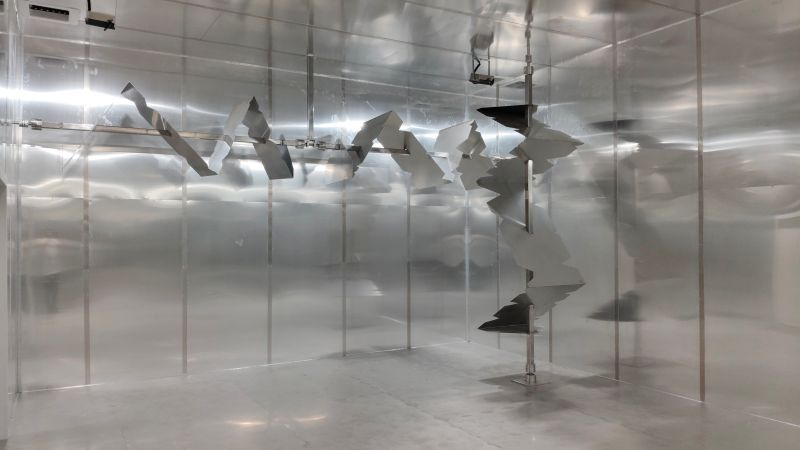
Reverberation Chamber in DO-160 Testing
The reverberation chamber method in DO-160 is primarily applied to:
- Section 20: RF Susceptibility Testing (radiated immunity)
- Section 21: RF Energy Emission Testing (radiated emission)
Standard Positioning:
| Test Type | Frequency Range | Method |
|---|---|---|
| Conducted susceptibility | 10kHz–400MHz | Current injection |
| Radiated susceptibility | 400MHz–18GHz | Anechoic chamber or reverberation chamber |
Reverberation Chamber vs Anechoic Chamber:
| Dimension | Anechoic Chamber | Reverberation Chamber |
|---|---|---|
| Field characteristic | Plane wave, fixed polarization | Statistically uniform, multi-polarization |
| Amplifier power | High | Low (cavity resonance) |
| EUT orientation | Multi-face照射 required | Single placement |
| Test time | Longer | Shorter |
| Cost | Higher (absorber material) | Lower |
Key Upgrade (DO-160F → DO-160G): Stirrer operation changed from stepped tuning to continuous stirring for faster, simpler, and more accurate testing.
Equipment Categories: B/D/F/G/L/M/O: Safety-critical systems (HIRF) R: Specific conditions S: Lowest test level T: General level W/Y: Dual standards
Capabilities:
- DO-160G Section 20.6 reverberation chamber RS: ✅ Full capability
- DO-160G Section 20.5 anechoic chamber RS: ✅ Optional
- DO-160G Section 21 reverberation chamber RE: ✅ Full capability
- Field uniformity calibration: ✅ Strict compliance
- CNAS accredited: ✅ Yes
The only private laboratory in South China with complete DO-160G reverberation chamber capability.