
International Certification
One Passport, Global Markets A Global Compliance White Paper for Brand Owners, Cross-Border Enterprises, and Product Manufacturers & R&D Teams
01 Executive Summary
Global trade barriers are shifting from tariffs to technical compliance. For wireless and electrical-electronic products, whether the corresponding market-access certification can be obtained in the target market directly determines whether the product can be listed, cleared through customs or admitted to tenders. Certification is no longer a “catch-up course” before launch; it is a “required course” at the product-definition stage. This white paper is written for three types of reader: · Brand owners: certification milestones must be written into the product roadmap, not remedied before launch. · Cross-border enterprises: a “one country, one file” compliance ledger must be maintained, with regulatory updates tracked dynamically. · Manufacturers and R&D teams: the principle of “test once, recognise in many markets” should be adopted to reduce duplicated testing costs. Core conclusions: 1. Certification is a ticket, not a cost. One step later in obtaining certification means one step later in losing shelf space and traffic. 2. The certification system is highly fragmented, which is the largest hidden cost of cross-border business. 3. Front-loading compliance can significantly shorten the time-to-market, saving an average of 4 to 8 weeks of corrective rework.
02 The Global Certification Landscape: Understanding Access Systems at a Glance
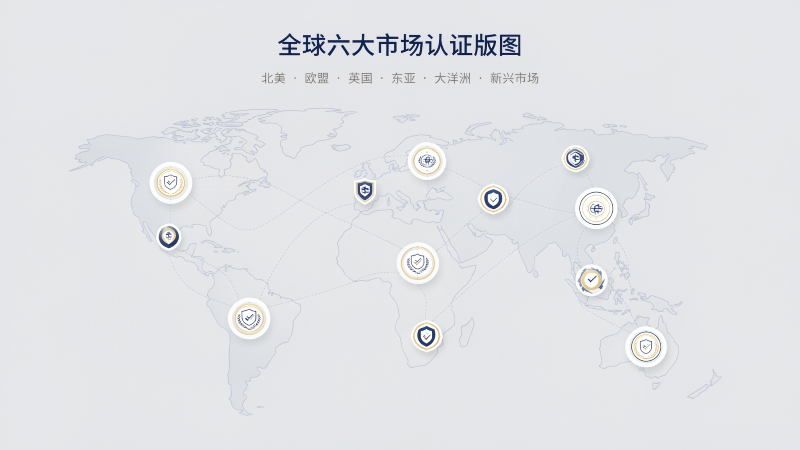
The figure below summarises the product certification systems of the world’s major markets. From FCC and IC in North America, CE and RED in the European Union, and UKCA in the United Kingdom, to CCC, SRRC, TELEC and KC in East Asia, and then to RCM in Oceania, SASO in Saudi Arabia, ANATEL in Brazil and ICASA in South Africa: the certification mark is the language of market access.
Key insight: whenever a product contains a transmitting function such as Wi-Fi, Bluetooth, 2G, 3G, 4G, 5G, SRD or LoRa, it almost inevitably falls within the scope of the target country’s radio certification. A certified module does not mean an exemption for the finished product; the finished product may still need to complete EMC, electrical safety and conformity assessment.
Quick Reference to Certification in Six Major Markets
| Market region | Main certification marks | Key notes |
|---|---|---|
| North America | United States: FCC, UL, ETL, DOE, MET; Canada: IC (ISED), CSA, cUL, NRCAN | FCC is mandatory for wireless equipment; DOE governs energy efficiency; UL and ETL are channel “soft thresholds”. |
| European Union | CE (RED, EMC, LVD), ErP, RoHS, REACH, WEEE | CE is a legal obligation; the RED directive covers all radio equipment. |
| United Kingdom | UKCA | An independent system after Brexit, progressively replacing CE. |
| East Asia | China: CCC, SRRC, CTA (network access licence); Japan: TELEC, PSE, VCCI; South Korea: KC | In China, SRRC governs type approval, CTA governs network access, and the two cannot be substituted for each other. |
| Oceania | Australia and New Zealand: RCM, SAA, GEMS, EESS | RCM is a mandatory conformity mark; GEMS governs energy efficiency. |
| Emerging markets | Brazil ANATEL; Mexico NOM or IFETEL; South Africa ICASA or NRCS; Saudi Arabia SASO or SABER; Singapore IMDA; Indonesia SDPPI; India WPC or BIS | Local testing accounts for a high proportion and lead times are long; schedule 6 to 12 months in advance. |
Table 3-1 Certification systems across six major markets
04 The Four-Step Compliance Method: Turning Certification into a Competitive Advantage
4.1 Certification planning (concept stage)
Define the countries of sale, determine the applicable regulations and standards, produce a Global Certification Roadmap, and estimate the schedule and budget. This step determines the total project duration. It is advisable to get involved at the ID design stage with antenna, RF, thermal and safety layouts, so as to avoid re-spinning the board after the tooling is complete.
4.2 Sample testing (late R&D stage)
Pre-scan, corrective action and formal testing. Pre-scanning can expose risks such as RF power, spurious emissions, ESD and surge in advance, and is the key to controlling the first-time pass rate.
4.3 Documentation review (in parallel with submission)
Technical documentation (TCF), user manuals, circuit block diagrams, BOM, English labels and warning statements. Documentation quality directly determines the first-time pass rate, and also serves as the basis for subsequent market spot checks and customs clearance verification.
4.4 Certification and defence (before and after launch)
Obtain the certificate, affix the mark, respond to annual factory inspections and market spot checks, and link with patent and trademark protection. Certification is not the finish line; continuous conformity maintenance is the moat of brand equity.
05 Action Recommendations by Role
| Role | Core pain point | Action recommendation |
|---|---|---|
| Brand owners | Certification milestones lag and drag down the new-product launch节奏 (pace) | Write certification into the product-definition document; count certification lead time backwards into the roadmap; build a global SKU certification matrix. |
| Cross-border enterprises | Regulations are updated rapidly and compliance records are scattered | Maintain a “one country, one file” ledger; subscribe to regulatory changes in target countries, such as the new EU RED, the UK UKCA transition arrangements, and the expansion of the Saudi SASO mandatory list. |
| Manufacturers and R&D teams | Excessive duplicated testing and high costs | Design the test plan on the basis of CB and MRA mutual recognition; coordinate module-level and finished-product-level certification planning. |
Table 5-1 Compliance action recommendations for the three reader groups
06 Three Truths Often Overlooked
1. 1. Wi-Fi and Bluetooth do not mean exemption from certification. As long as a product contains a transmitting function, it almost inevitably falls within the scope of the target country’s radio certification. 2. 2. CE is not something you “obtain from an authority”. It is the manufacturer’s declaration of conformity, but it must be backed by traceable test evidence and technical documentation (TCF). 3. 3. Module certification is not equivalent to finished-product exemption. Even when a certified module is used, the finished product may still need to undergo EMC, electrical safety and conformity assessment.
Conclusion
Compliance is not an endpoint; it is the starting point of a brand’s globalisation. When a product carries real certificates to overseas markets, what it carries is not only technical specifications, but also consumers’ trust in quality. Quality is witnessed in the details - let every certification become an appreciation of brand equity.
Appendix A Common Certification Abbreviations
| Abbreviation | Full name / description | Market |
|---|---|---|
| FCC | Federal Communications Commission, the United States communications regulator | United States |
| CE | Conformite Europeenne, European conformity marking | European Union |
| RED | Radio Equipment Directive (2014/53/EU) | European Union |
| UKCA | UK Conformity Assessed | United Kingdom |
| CCC | China Compulsory Certification | China |
| SRRC | State Radio Regulation Committee, radio-transmission equipment type approval | China |
| CTA | China Telecom Equipment Network Access Licence, administered by MIIT | China |
| TELEC | Telecom Engineering Center, Japan radio equipment certification body | Japan |
| KC | Korea Certification | South Korea |
| RCM | Regulatory Compliance Mark, Australia and New Zealand supplier declaration mark | Oceania |
| ANATEL | Agencia Nacional de Telecomunicacoes, Brazil’s national telecommunications agency | Brazil |
| ICASA | Independent Communications Authority of South Africa | South Africa |
| SASO | Saudi Standards, Metrology and Quality Organization | Saudi Arabia |
| SABER | Saudi product conformity and shipment-certificate electronic service platform | Saudi Arabia |
| IMDA | Info-communications Media Development Authority | Singapore |
| SDPPI | Sertifikasi Perangkat Telekomunikasi, telecommunications equipment certification | Indonesia |
| WPC | Wireless Planning and Coordination Wing, India’s frequency and wireless equipment authority | India |
| BIS | Bureau of Indian Standards | India |
| NOM | Norma Oficial Mexicana, Mexico’s official standard | Mexico |
| IFETEL | Instituto Federal de Telecomunicaciones, Mexico’s federal telecommunications regulator | Mexico |
Table A-1 Common certification abbreviations (partial list)
Apendix B Typical Certification Lead Times and Recommended Lead Buffer
| Market / certification | Standard lead time (working days) | Recommended lead buffer |
|---|---|---|
| United States, FCC | 2 to 4 weeks | 3 months |
| European Union, CE or RED | 3 to 6 weeks | 4 months |
| United Kingdom, UKCA | 3 to 6 weeks | 4 months |
| China, CCC | 6 to 10 weeks | 5 months |
| China, SRRC | 4 to 8 weeks | 4 months |
| Japan, TELEC | 4 to 8 weeks | 5 months |
| South Korea, KC | 6 to 10 weeks | 5 months |
| Brazil, ANATEL | 8 to 14 weeks | 6 months |
| Saudi Arabia, SASO or SABER | 4 to 8 weeks | 4 months |
| Australia, RCM | 2 to 4 weeks | 3 months |
Table B-1 Lead-time data are industry reference values; actual schedules are subject to the issuing body’s queue.